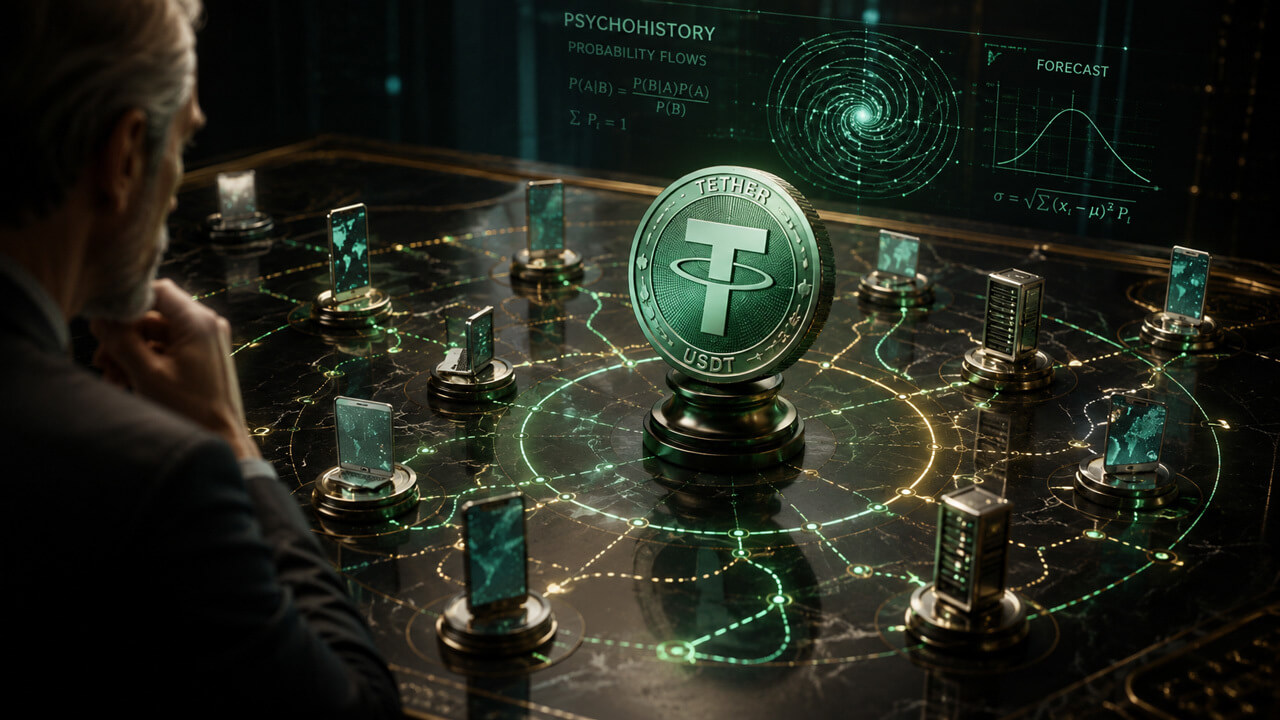
Tether has launched QVAC Psy, a decentralized artificial intelligence project built on principles inspired by Isaac Asimov's Foundation series. The stablecoin issuer positions the initiative as its "second reserve asset" beyond traditional collateral holdings.
QVAC Psy operates as a family of foundational AI models rooted in psychohistory, the fictional framework from Asimov's universe where mathematician Hari Seldon predicts societal outcomes using mathematics, statistics, and social dynamics. Tether frames this as a move toward decentralized, locally-run AI systems rather than centralized cloud infrastructure.
The project represents Tether's expansion into artificial intelligence infrastructure. Rather than serving as a direct revenue generator, QVAC Psy positions AI capabilities as a strategic reserve asset alongside Tether's USDT stablecoin reserves. This aligns with broader industry trends where major crypto players diversify into adjacent technologies.
Tether's motivation appears tied to reducing dependence on centralized AI providers and building sovereign computing infrastructure. The decentralized local AI approach gives users control over model execution without reliance on OpenAI, Google, or other major vendors. This resonates with crypto's core philosophy around decentralization and self-custody.
The Foundation reference carries symbolic weight. Asimov's psychohistory predicts long-term societal collapse and recovery through mathematical models. Tether's framing suggests ambitions to apply similar predictive frameworks to market dynamics, on-chain analytics, or economic patterns within crypto ecosystems.
Details remain sparse on tokenomics, integration mechanisms, or timeline. The announcement lacks specifics on how QVAC Psy generates returns or interacts with USDT. Tether has built credibility and resources to pursue moonshot projects, though skepticism typically greets such ambitious pivots from stablecoin operators.
This move differs sharply from typical Tether announcements focused on reserve transparency or regulatory compliance. The company stakes itself in the emerging AI infrastructure race, betting that decentralized models matter for