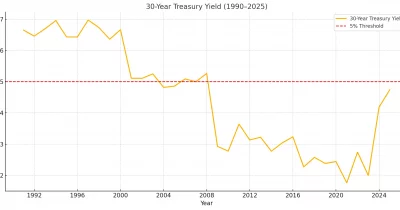
The US 30-year Treasury yield approaches 5%, a level that threatens to redirect capital away from crypto and risk assets toward traditional fixed-income instruments. This shift reflects mounting fiscal uncertainty and investor appetite for safer yield-generating options.
Higher long-term yields make bonds increasingly attractive relative to volatile digital assets. Bitcoin and Ethereum have historically struggled when real yields rise, as the opportunity cost of holding non-yielding assets grows. The current bond market trajectory pressures risk sentiment broadly, with the 30-year yield serving as a barometer for long-term economic expectations and inflation assumptions.
Fiscal concerns drive the yield spike. Federal spending, debt ceiling dynamics, and inflation persistence keep Treasury yields elevated. Investors reassessing portfolio allocations now face a genuine choice. A 5% risk-free return on 30-year Treasuries competes directly with crypto's volatile upside. This dynamic becomes especially acute for retail and institutional investors managing retirement portfolios or conservative allocation bands.
Crypto market participants monitor yield levels closely. Previous episodes of rising real rates corresponded with crypto drawdowns. When the Fed tightened in 2022, Bitcoin declined over 65% from its 2021 peak as bond yields climbed. Current momentum mirrors that pattern, though less dramatically so far.
On-chain data shows mixed signals. Bitcoin and Ethereum have maintained relative stability despite macro headwinds, suggesting some decoupling from traditional markets. However, sustained yields above 5% could test that resilience. Stablecoin flows and exchange inflows sometimes spike during risk-off periods as traders reduce exposure or rotate into cash positions.
The crypto market now prices in a regime where bonds offer real returns. Deflationary assets like Bitcoin face headwinds in this environment, though some argue Bitcoin's scarcity appeal remains intact regardless of bond yields. DeFi protocols offering yield through lending mechanisms may see increased adoption as users chase returns, but high-risk protocols suffer first when risk aversion peaks.
This tipping point matters. The 5% level forces institutional portfolio managers to recalculate crypto allocations. If yields sustain or rise