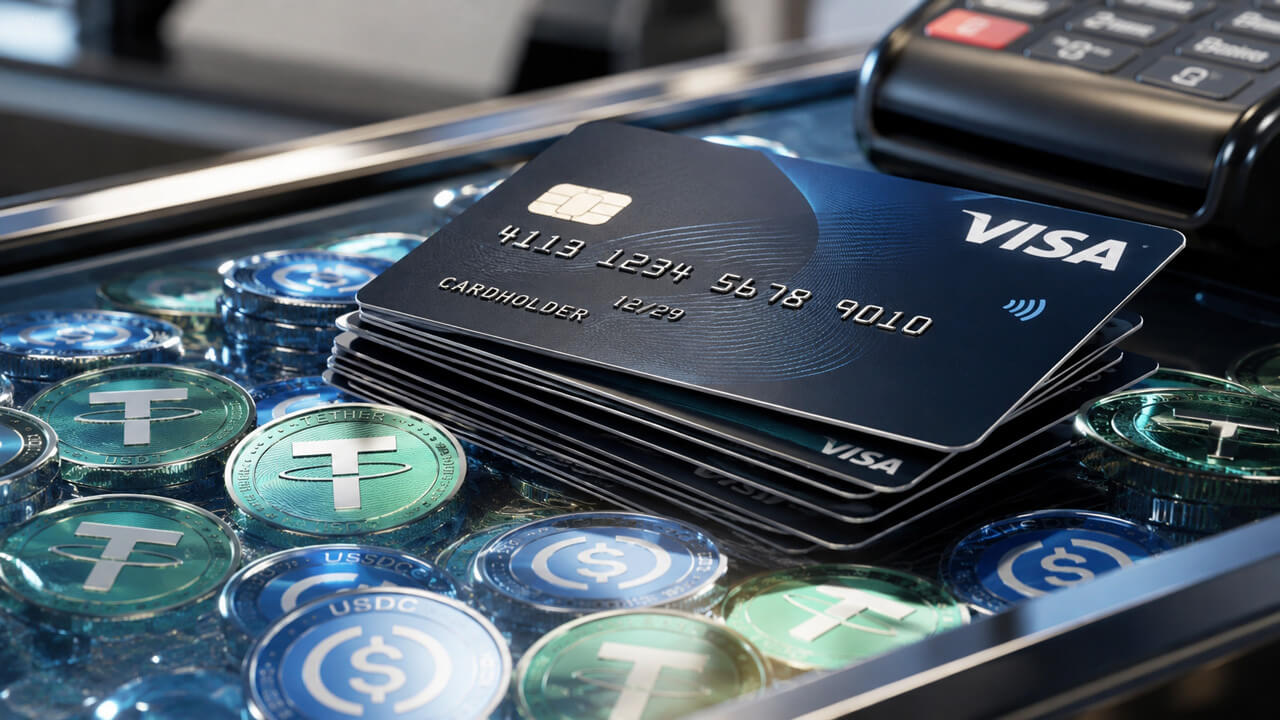
Stablecoins promised to eliminate payment intermediaries, yet Visa has become the dominant rails for on-chain crypto card spending. Data from The Kobeissi Letter tracks crypto-card volume at roughly $600 million monthly, with $7.2 billion in cumulative on-chain card transactions. This contradicts the original stablecoin thesis. Users spend USDC, USDT, and other stablecoins through Visa-linked crypto debit cards, meaning the legacy payment giant captures transaction value that decentralized networks were meant to capture.
The irony runs deep. Stablecoins like USDC and USDT were architected to bypass traditional rails entirely. Direct peer-to-peer transfers would theoretically eliminate card networks, payment processors, and banking intermediaries. Instead, consumer adoption patterns show users prefer the safety and merchant acceptance of Visa integration. Crypto debit cards bridge on-chain assets to offline retail, making Visa the gatekeeper for mainstream stablecoin usage.
This trend reveals a practical market reality. Most merchants still lack native crypto payment infrastructure. Visa's global network and fraud protection create trust that pure blockchain transactions cannot match for everyday commerce. Users accept the trade-off: keeping Visa in the loop preserves real-world utility.
The $7.2 billion figure signals serious adoption, but it also shows where stablecoin value extraction actually flows. Visa captures interchange fees and transaction data that DeFi protocols never touch. Circle and Tether generate volume on their stablecoins, yet benefit from legacy payment network liquidity more than peer-to-peer settlement.
Market data indicates crypto cards remain a niche compared to traditional payment volume, but growth trajectories are steep. If this trend continues, stablecoin adoption becomes inseparable from traditional finance infrastructure. The original vision of disintermediation gave way to a hybrid model where Visa profits from every stablecoin transaction at checkout.
This represents a partial victory for crypto adoption. Stablecoins reached consumers. Mainstream commerce now touches blockchain rails. But the victory