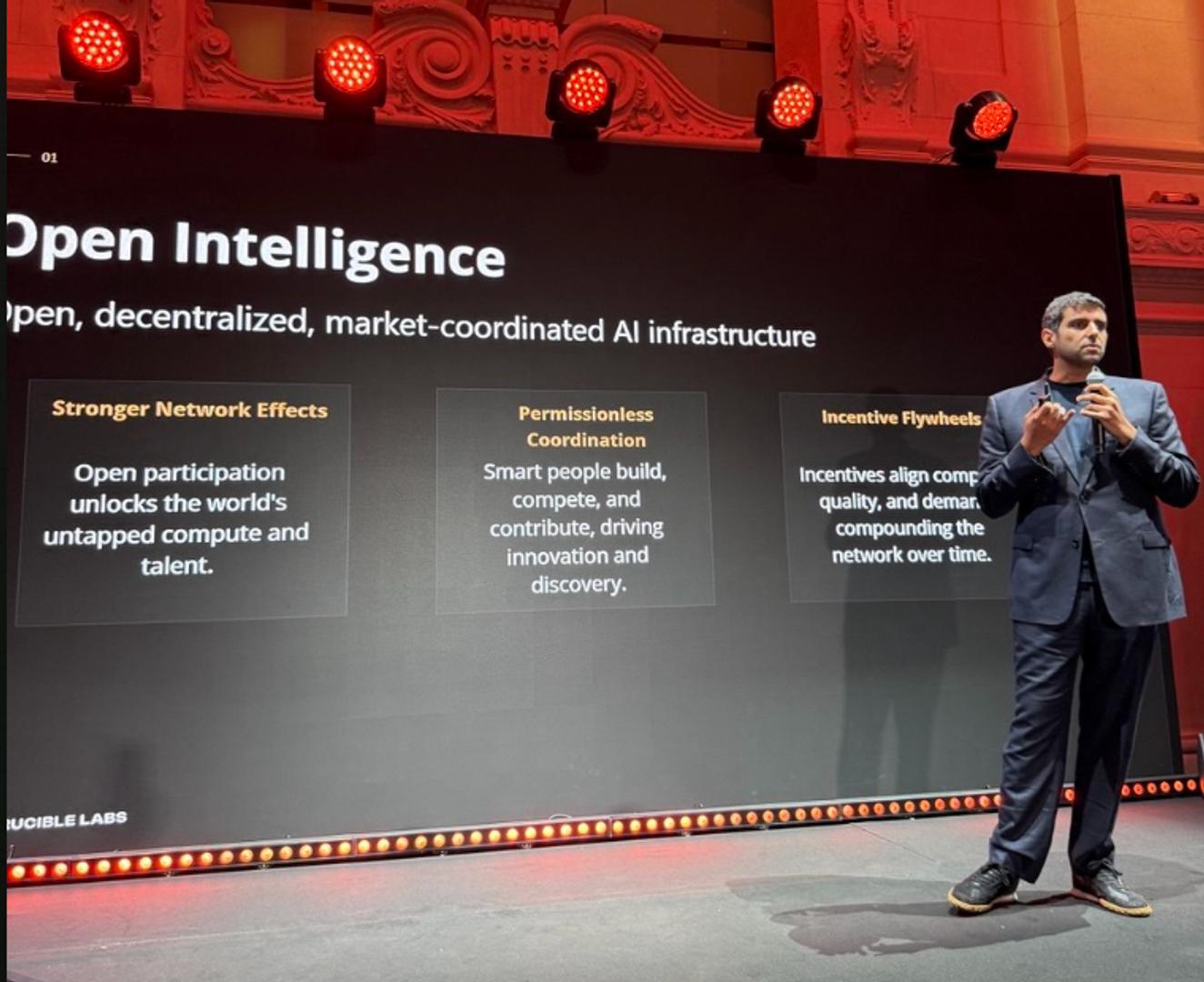
Bitcoin's hashrate eclipses the combined computational capacity of the world's 100 fastest supercomputers by roughly 600,000 times, according to Ala Shaabana, co-founder of Bittensor. This staggering disparity highlights an untapped resource that could reshape AI infrastructure if properly leveraged.
Bittensor operates as a decentralized machine learning protocol where validators and miners stake TAO tokens to participate in a peer-to-peer network for AI model training and inference. The platform applies Bitcoin's core mechanism—coordinate-and-reward systems—to break corporate monopolies that currently control large language models and compute resources.
Shaabana's argument centers on the inefficiency of current AI compute distribution. Major players like OpenAI, Google, and Anthropic concentrate massive computational resources. Bitcoin demonstrates an alternative: millions of nodes collectively performing work without centralized gatekeeping. Applying this playbook to AI could distribute model training and inference across thousands of independent operators, reducing reliance on proprietary closed systems.
Bitcoin's network currently processes around 500+ exahashes per second. While this power optimizes for cryptographic puzzle-solving rather than AI computation, the underlying principle of distributed coordination remains transferable. Bittensor has positioned itself as the bridge, creating economic incentives for miners to contribute compute to machine learning tasks rather than pure proof-of-work mining.
The TAO token price has experienced volatility, trading between $300-$600 ranges in 2024, reflecting both adoption momentum and broader crypto market swings. Bittensor's validator count and active subnet growth indicate growing developer interest in decentralized AI infrastructure.
Shaabana's comparison does more than cite numbers. It signals a philosophical shift gaining traction in crypto circles: distributed systems can challenge entrenched corporate control. If Bittensor or similar protocols successfully route Bitcoin-scale compute toward AI workloads, they could fundamentally alter the landscape where OpenAI and other centralized entities set terms for everyone else.
The practical challenge remains steep. Converting hashpower designed for SHA-256 operations