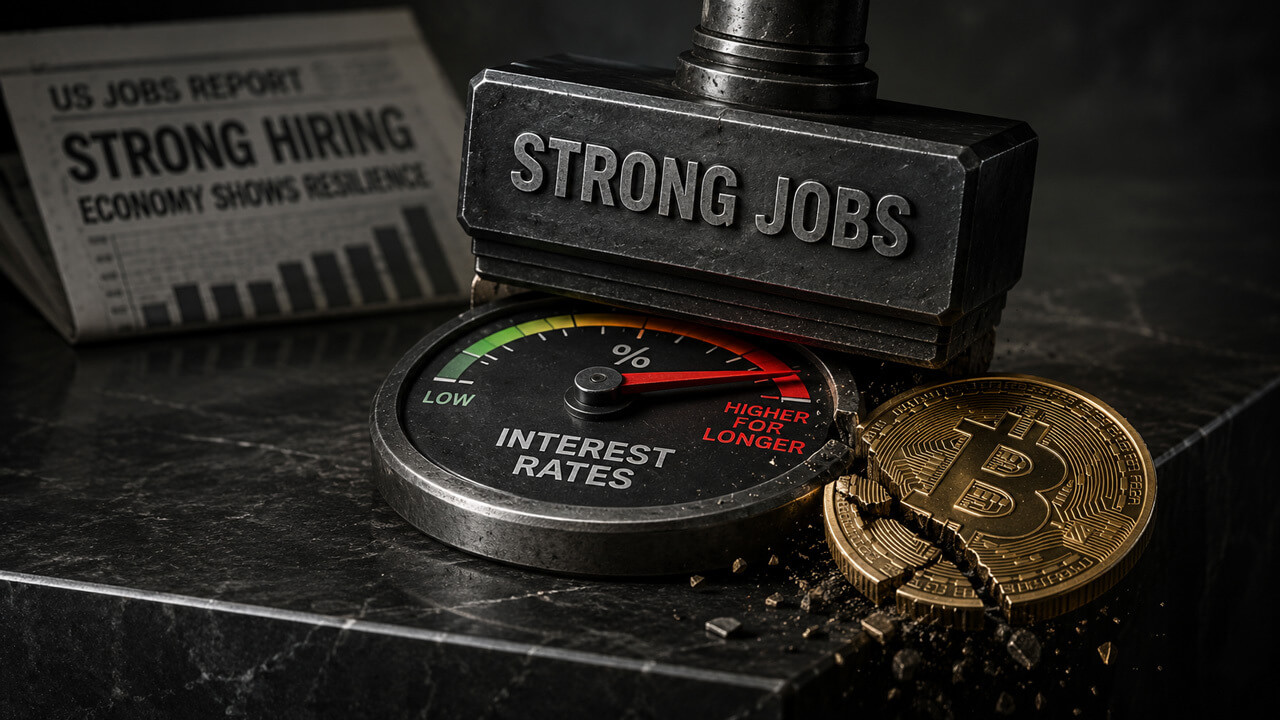
The US jobs market delivered a surprise shock in May, adding 172,000 positions versus the 80,000 economists predicted. The unemployment rate remained steady at 4.3%, and the Bureau of Labor Statistics revised March and April figures upward by a combined 93,000 jobs, painting a stronger spring labor market than previously reported.
This stronger-than-expected employment data triggers immediate consequences for asset prices. Higher job creation reduces the likelihood of Federal Reserve rate cuts in the near term. Markets had priced in potential relief from elevated interest rates, betting on economic softening that would force the Fed's hand. Instead, the jobs report signals resilience in the real economy, keeping inflation pressures intact and justifying sustained rate levels.
Bitcoin and other risk assets react negatively to rate hold signals. With the Fed on pause, borrowing costs remain elevated. This environment favors dollar holdings and bonds over speculative assets like crypto. Bitcoin trades inverse to real interest rates. When rate cut expectations fade, the opportunity cost of holding zero-yield Bitcoin increases. Investors rotate into fixed-income instruments offering 5%+ returns with minimal risk.
The implications ripple across consumer finance. Higher rates mean pricier mortgages, auto loans, and credit card debt. This cooling effect on discretionary spending eventually flows into corporate earnings forecasts, pressuring equity valuations. Crypto, as a risk-on asset class, faces headwinds alongside equities when the Fed signals policy persistence.
The Fed faces a delicate balancing act. The May jobs report shows no need for emergency cuts to prevent recession, but a still-elevated unemployment rate and moderating wage growth suggest the labor market is cooling gradually. The Fed likely holds rates steady through mid-2024 unless inflation retreats faster or labor weakness accelerates.
Bitcoin's immediate response reflects this calculus. Traders dumped positions anticipating the Fed stays restrictive longer. The crypto market had positioned for a pivot toward monetary easing. This jobs report killed that narrative, at least temporarily.
The May employment data reframes the entire year ahead. A persistently strong labor market buys the Fed time to hold rates higher, fighting inflation without triggering recession. For crypto investors, that means patience. Rate cuts remain conditional on deteriorating employment or inflation surprise drops. Until then, Bitcoin competes with Treasury yields and dollar strength in a higher-for-longer rate environment.