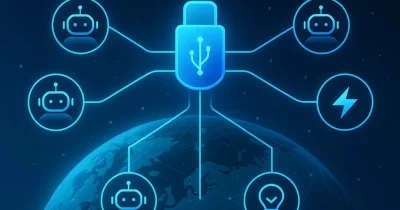
Fetch.AI rolled out a comprehensive agentic infrastructure platform combining "Your Personal AI" and "Agentverse," positioning itself as a foundational layer for autonomous agent transactions and AI-driven marketplaces.
The infrastructure centers on enabling autonomous agents to execute transactions, negotiate, and interact within decentralized networks without constant human oversight. Your Personal AI functions as an agent layer tailored to individual users, handling tasks and decision-making on their behalf. Agentverse serves as the marketplace and coordination layer where these agents can discover each other, form partnerships, and execute smart contracts autonomously.
Fetch.AI's thesis targets a gap in current blockchain and AI infrastructure. While decentralized finance protocols handle token swaps and lending, and AI models power language and vision tasks, neither layer tackles autonomous economic coordination between independent agents at scale. The protocol aims to bridge this by creating a permission-less environment where agents can transact, bid for services, and settle autonomously without intermediaries.
The architecture carries implications for several adjacent sectors. Supply chain automation could see agents bidding for transport and logistics services in real time. Decentralized data markets could rely on agents negotiating data sales without human intervention. Energy grids could deploy agents that balance load and negotiate pricing dynamically.
The infrastructure launch follows Fetch.AI's earlier work on DeFi integrations and agent-based market simulations. The token FET has tracked broader market sentiment but remains positioned as the settlement and incentive layer within the Agentverse ecosystem. Users staking or operating nodes within the network require FET for gas fees, governance, and agent deployment.
The competitive landscape features other agent-focused protocols like AI16Z and general-purpose layer-one blockchains targeting autonomous execution. Fetch.AI distinguishes itself through its agent-native design rather than bolting agent capabilities onto existing chains.
The core value proposition hinges on whether autonomous agents can efficiently coordinate economic activity. Early use cases in grid management and supply chain optimization demonstrate viability. Broader adoption depends on network effects. As more agents join Agentverse and integrate services, transaction volume and FET demand could accelerate.
The infrastructure remains in early deployment phases. Real-world transaction volume, agent adoption rates, and competitive responses from layer-one blockchains will determine whether Fetch.AI captures meaningful share of autonomous transaction activity.