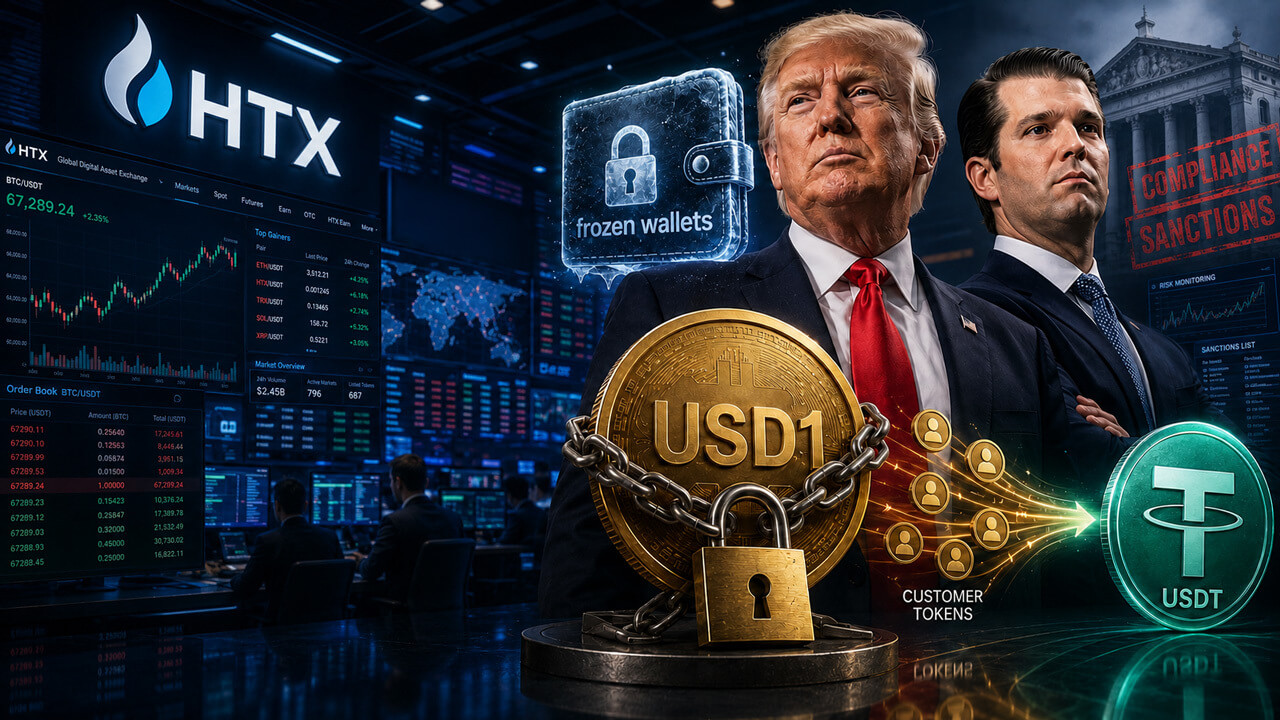
HTX will permanently delist USD1, the stablecoin backed by Donald Trump and World Liberty Financial, beginning June 7. The exchange will automatically convert all eligible retail customer USD1 holdings into Tether (USDT) at a strict one-to-one rate, forcing affected users into a mandatory token swap.
This delisting represents direct retaliation in an escalating feud within Trump's crypto circle. World Liberty Financial previously froze HTX's wallet holdings, prompting the exchange to take unilateral action against USD1 holders on its platform. The move puts retail traders caught in the middle of a family business dispute at direct risk of forced conversions without their explicit consent.
USD1 launched as a Trump-family-aligned stablecoin project, positioning itself as an alternative to USDT and USDC. The token struggled to gain meaningful adoption and faced skepticism from the broader crypto community over governance concerns and the concentration of backing behind a single political figure. HTX's delisting decision signals that major exchanges no longer view the stablecoin as viable infrastructure.
The conversion mechanism matters here. By forcing a one-to-one swap into USDT, HTX avoids liquidity problems that might arise from dumping USD1 into open markets. However, customers holding USD1 for specific reasons now lose optionality. They cannot choose timing, cannot route to different stablecoins based on yield opportunities, and cannot protest the decision through their own wallet actions.
World Liberty Financial's wallet freeze on HTX appears to have been a retaliatory move itself, suggesting deeper operational breakdowns between the project and the exchange. In traditional finance, such disputes would trigger regulatory intervention and customer protection mechanisms. Crypto remains in a gray zone where exchanges retain substantial power over customer assets, and customer recourse remains limited.
The June 7 deadline gives HTX customers roughly two weeks to either withdraw USD1 before conversion or accept the forced USDT swap. Any remaining balances after the cutoff will automatically convert at the stated rate. This structure benefits neither the customer nor USD1's liquidity prospects. It signals capitulation from a major exchange and accelerates the token's march toward obsolescence.
For Trump's broader crypto ambitions, this incident demonstrates operational friction and reputational risk. Major exchanges view USD1 as a liability rather than a promising asset. The forced conversions also highlight the inherent power asymmetry in centralized exchange custody, a tension that crypto advocates consistently cite when promoting self-custody and decentralized alternatives.