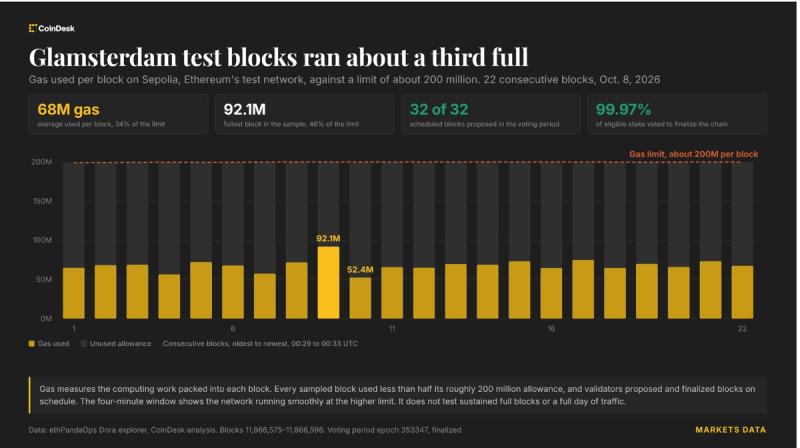
Ethereum's Sepolia testnet has completed upgrade trials that increased its processing capacity to nearly 200 million gas per block, according to CoinDesk. The upgrade raised the network's processing budget more than threefold compared to previous levels.
During the test runs, however, sampled blocks consumed less than half of the newly expanded allowance. This gap between available capacity and actual usage suggests the network maintained headroom despite the increased throughput capability.
The Glamsterdam upgrade represents a significant shift in Ethereum's scaling approach on the testnet. Sepolia serves as a rehearsal ground where developers validate protocol changes before implementation on the mainnet. The tripling of gas per block would substantially expand transaction processing capabilities if applied to Ethereum's main network.
The discrepancy between allocated and used gas capacity indicates that real-world demand on Sepolia did not immediately fill the expanded processing budget during testing. This observation is typical during upgrade rehearsals, where network conditions may differ from production environments.
Ethereum has pursued multiple scaling strategies, including layer 2 solutions and protocol-level optimizations. This gas increase on Sepolia demonstrates the network's continued exploration of increasing base layer throughput. The test results provide developers with empirical data on how the network performs with expanded capacity before any potential mainnet deployment.
The success of the Glamsterdam trials on Sepolia establishes proof of concept for higher gas limits. Whether this upgrade moves to mainnet depends on community consensus and ongoing protocol development discussions.